
REVIEW · 1-DAY TOURS
Best of Bologna in one day : Food, architecture, art and history
Bologna rewards curious walkers. This seven-hour private tour brings together medieval architecture and major art, then adds a generous tasting of local food and a short pasta class. I especially like the chance to see places many visitors miss, including the anatomical theatre and the Oratory of Santa Cecilia. I also like that guide Riccardo Bacchi connects paintings, religion, science, food, and city politics instead of treating each sight as an isolated stop.
The main drawback is the pace. You cover a lot of ground and absorb a great deal of information, so this is not a relaxed stroll with long pauses. Comfortable walking shoes are essential, and you need to listen closely to get the most from Riccardo’s detailed explanations.
Key points at a glance
- A private, seven-hour route covering Bologna’s squares, churches, museums, canals, university buildings, and food quarter.
- Riccardo Bacchi leads with an art historian’s eye, linking works by Michelangelo, Raphael, Titian, Carracci, Guercino, and local masters to Bologna’s story.
- The Archiginnasio and anatomical theatre offer one of the day’s most unusual stops, especially for visitors interested in medicine and science.
- The Quadrilatero food quarter leads into a long tasting, with mortadella, culatello, Parmigiano Reggiano, lasagne, tagliatelle, balsamic vinegar, and other local specialties.
- A short pasta lesson explains the dough used for tagliatelle, tortellini, lasagne, balanzoni, tortelloni, and passatelli.
- The tour suits first-time visitors with limited time, but the fast rhythm may feel demanding if you prefer slow museum visits.
Why this Bologna tour works so well in one day
Bologna is easy to underestimate. Many visitors come for food, see a few arcades, and move on. That misses the city’s unusual mix of medieval civic power, early university culture, Renaissance art, religious drama, and working food traditions.
This tour gives you a broad introduction without splitting the city into unrelated pieces. The main square explains public life. The churches show how art served faith and local families. The university buildings reveal Bologna’s role in European learning. The Quadrilatero then turns those ideas into lunch.
I like that the experience is private, with only your own group taking part. That matters here because the route contains many details that need explanation. Riccardo Bacchi is praised for his command of art, architecture, religion, science, and medieval history, but his teaching style also sounds demanding. You are expected to pay attention and take part.
The price is $174.69 per person. That is not a budget walking tour, but the value depends on how you use it. Admission is included at the main paid sights, the food tasting is included, and the pasta class is included. You also receive a full day with a specialist guide rather than a short orientation walk.
If you planned to visit several museums and churches alone, pay separate entrance fees, find the food quarter, and make sense of what you were seeing, the cost becomes easier to justify. If you only want a casual introduction to Bologna, it may feel like too much time, information, and money.
More history tours in Bologna:
- Bologna: Street Food Tour in the Historic Center
★ 4.8 · 125 reviews - Barcelona: Tapas Walking Tour with Food, Wine, and History
★ 4.8 · 4,261 reviews - Sevilla Food Tour: Tapas, Wine, History & Traditions
★ 5.0 · 3,468 reviews
Piazza Maggiore: Bologna’s civic stage
The day begins at Bar Vittorio Emanuele on Piazza Maggiore, a practical meeting point in the heart of town. This is the right place to start because the square gathers many of Bologna’s central themes in one view.
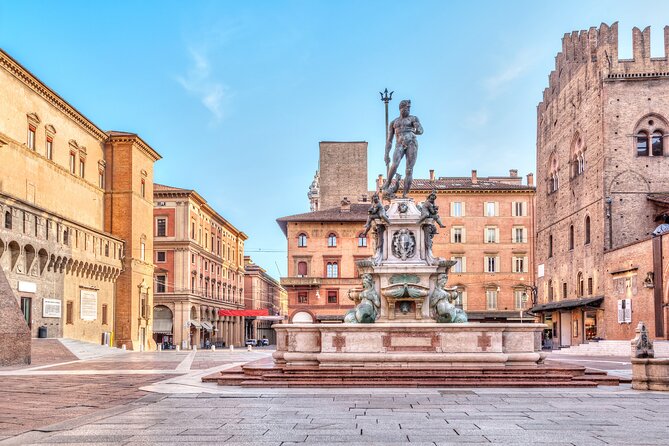
Riccardo explains the Fountain of Neptune, Palazzo Comunale, and the Basilica of San Petronio. You also look at terracotta sculpture by Nicolò dell’Arca, whose work appears again later in the church of Santa Maria della Vita. That connection helps you see how Bologna’s artists worked across religious and civic settings.
The Palazzo Comunale visit adds more than an exterior photograph. You enter frescoed rooms and see the grand staircase associated with Bramante’s horses, along with smaller decorative details inside the building. The stop lasts about 40 minutes, long enough for context but not enough for a slow architectural study.
I would pay close attention here. The square can seem straightforward at first, but the political and religious meaning of its buildings is part of what makes Bologna different from a simple collection of Italian monuments.
Santo Stefano and Santa Maria della Vita
Piazza Santo Stefano offers a change of scale. Instead of one grand building, you see a group of early medieval and Romanesque structures, later Gothic additions, frescoes, porticoes, stairways, and a terrace with views toward Bologna’s towers.
The scheduled visit is about 20 minutes, so expect an introduction rather than a full inspection of every room. The complex can be confusing without guidance, and that is where a clear explanation helps. The buildings developed over time, so their different forms tell a story of changing religious and civic needs.
The tour also includes the Basilica Santuario di Santo Stefano later in the route. The two entries appear to concern the same broader complex, with the first stop focusing on its setting and features, and the later stop giving the basilica itself more attention. That repeated attention is useful if you want to understand the site, though it may feel less varied than visiting a completely different monument.
At Santa Maria della Vita, the mood shifts to dramatic Baroque faith. The main reason to visit is Nicolò dell’Arca’s Lamentation, a terracotta group with intense movement and emotion. The church stop lasts about 20 minutes, but the sculpture deserves focused attention.
This is one of those places where a guide can help you look past the room and toward the figures themselves. I would not rush this stop simply because it is short. The work is a major artistic moment in the day.
The Archiginnasio and Bologna’s medical past
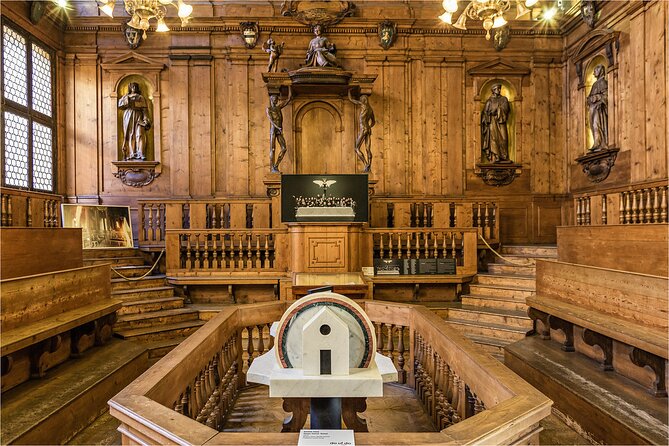
The Archiginnasio is one of the strongest stops for visitors who want more than churches and paintings. This Renaissance and Baroque palace was tied to the University of Bologna and contains frescoes, historic books, and the wooden anatomical theatre.
The theatre is particularly memorable because it brings the university’s scientific life into view. You are not just hearing that Bologna was an important centre of learning. You see the setting where medical teaching took place, surrounded by woodwork and decoration.
Past visitors have especially valued this part of the route, including people interested in science and medical history. That makes sense. The anatomical theatre gives the day a welcome change of subject after the churches and sculptures.
The 20-minute stop is efficient, not leisurely. If you love historic interiors, you may wish it lasted longer. Still, Riccardo’s explanations help you understand why the building matters, rather than leaving you to admire the woodwork without context.
A few more food tours in Bologna worth a look
- Florence: Cinque Terre Park Day Trip with Optional Street Food
★ 4.5 · 3,593 reviews - Florence: Day Trip to Cinque Terre with Optional Street Food
★ 4.5 · 2,854 reviews - Florence: Cinque Terre Day Trip with Optional Street Food
★ 4.5 · 1,315 reviews - Gran Canaria: Catamaran Day Trip with Food and Drinks
★ 4.8 · 845 reviews
Pinacoteca Nazionale: a concentrated art lesson
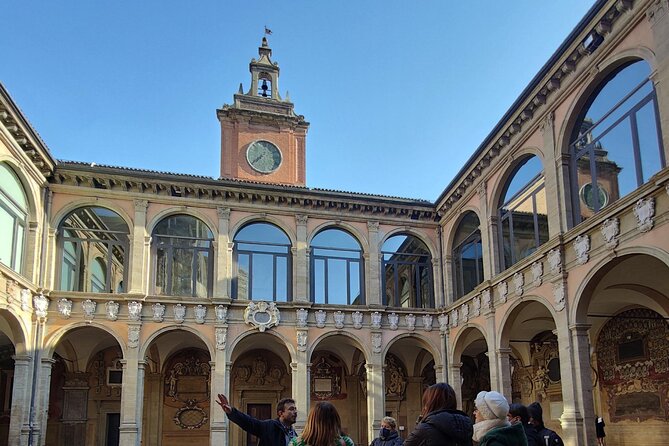
The National Art Gallery of Bologna receives about 40 minutes. Its collection reaches from Giotto to Raphael, Titian, Parmigianino, Guido Reni, the Carracci family, Guercino, Ercole de’ Roberti, and local artists such as Vitale da Bologna.
That is a lot of art for one visit. You will not see every painting in depth, and you should not expect a quiet, unhurried museum morning. Instead, the value comes from selection and explanation. Riccardo can point out the works that matter most and explain how Bologna fits into wider Italian painting.
I like this kind of museum visit for a first day because it gives you a framework. Later, if you return on your own, you will know which artists and periods deserve more time.
The drawback is information overload. The tour covers medieval and Renaissance art in several churches and buildings before reaching the gallery. If you are already tired, the Pinacoteca may require extra concentration. A private format helps because the pace can be more responsive than a large group tour, but the overall day remains full.
The Quadrilatero: from monuments to lunch
The Quadrilatero is Bologna’s historic market quarter, with old stalls, food shops, taverns, and traditional businesses. This is where the tour moves from looking at food culture to tasting it.
The route includes a substantial sampling at Bruno e Franco, La Salumeria. The listed food includes figs with Parma ham, culatello, salami, mortadella, pasta, Bologna-style meatballs with peas, tagliatelle with ragù, Parmigiano Reggiano aged three or four years, traditional green lasagne, and Modena balsamic vinegar aged as long as 24 years.
That is much more than a token snack. It gives you a useful introduction to the local table, especially if you have little time in Emilia-Romagna. The tasting lasts about an hour, and it is one of the clearest reasons the tour costs more than a standard city walk.
I would arrive hungry. The food portion is meant to function as a proper part of the day, not a quick bite between churches. It also gives Riccardo a chance to explain why Bologna’s famous dishes are tied to local ingredients and traditions.
Food names can be confusing in Italy, and Bologna is no exception. Tagliatelle, tortellini, lasagne, mortadella, culatello, and balsamic vinegar each carry a different local story. Tasting them in one place makes those distinctions easier to remember.
The pasta lesson: a small but useful finish
After the tasting, you take part in a 30-minute pasta-making class. The focus is pasta dough with egg, used for tagliatelle, tortellini, lasagne, balanzoni, tortelloni, and passatelli.
Do not expect a full culinary workshop in half an hour. The value is in seeing the basic process and understanding how one dough can lead to several familiar dishes. For many people, this is the most practical part of the day because it connects a famous meal with the hands-on work behind it.
The class also rounds out the tour. You begin with monuments and paintings, then finish by seeing how Bologna’s identity continues through food preparation. That link is one of the tour’s best ideas.
San Giacomo Maggiore and the Oratory of Santa Cecilia
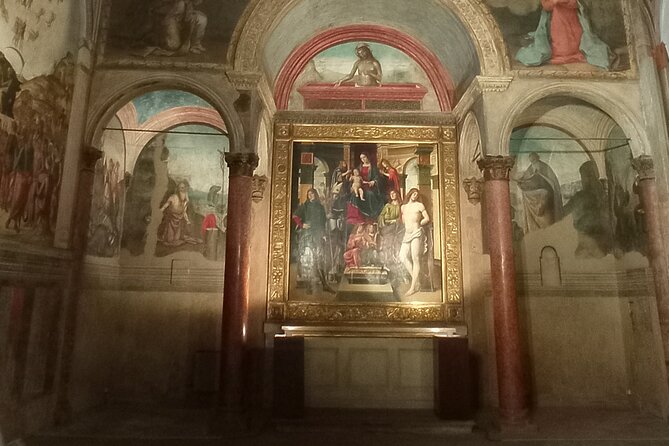
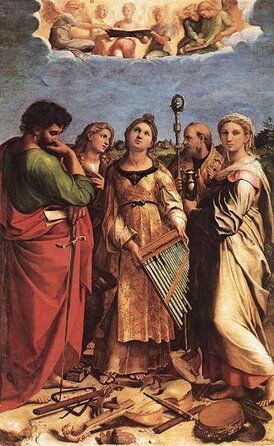
The Church of San Giacomo Maggiore is described as an art-filled church, with the Bentivoglio Chapel as a major highlight. The chapel reflects the Emilian Renaissance and shows how a powerful local family used art and architecture to present its position.
The nearby Oratory of Santa Cecilia adds frescoes and musical associations. Together, the church and oratory give you a good sense of Bologna’s layered religious spaces. They are not simply grand shells. They contain family ambition, devotional art, painted storytelling, and music.
This stop lasts about 40 minutes. That is helpful because there is enough time to compare the chapel and the oratory instead of making a quick entrance and exit.
The Canale delle Moline and small details
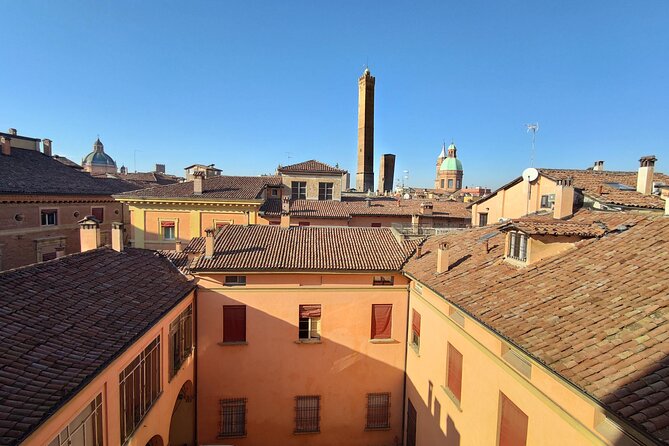
The Canale delle Moline receives only about five minutes, so treat it as a quick visual pause rather than a full canal walk. The area brings together towers, arcades, medieval houses, palaces, unusual architecture, concealed waterways, grand staircases, frescoed rooms, oratories, and university sites.
Five minutes cannot cover all those subjects in detail. The purpose seems to be showing you another side of Bologna, one that can disappear behind the city’s porticoes and main squares. I like this kind of short stop because it breaks up the museum rhythm, though anyone seeking a long canal exploration may find it brief.
San Domenico and the art of memory
The Basilica of San Domenico is another major art stop. Its treasures include the Ark of Saint Dominic, with work associated with Nicola Pisano, Nicolò, and Michelangelo. The church also contains an elaborate wooden choir, an organ connected with Mozart’s visits, and a Renaissance cloister.
The Ark alone gives the visit real weight. It brings together sculpture from different hands and periods, allowing Riccardo to explain how a single monument developed over time. The wooden choir and cloister then broaden the stop beyond one famous object.
The basilica receives about 40 minutes. That is enough for a guided overview, though art lovers may want to return later for a slower look. The site is especially suited to you if you enjoy seeing how architecture, sculpture, music, and religious practice overlap.
How the pace and guide shape the day
The strongest feature here is not simply the number of stops. It is Riccardo Bacchi’s role as an interpreter. His background as a university professor and art historian comes through in the way he connects subjects and explains small details.
You should expect a serious amount of information. The experience is described as educational, passionate, and unusually thorough, but also fast-moving. Some people may find the explanations demanding, especially when medieval politics, art history, religion, and architecture come together in one discussion.
I would choose this tour if you like asking questions, noticing details, and understanding why a place matters. I would not choose it if your ideal day is mostly wandering, shopping, and stopping for long coffee breaks.
The private format is a real advantage. Riccardo can tailor parts of the route to your interests, and he has helped visitors focus on science, medicine, photography, or particular art periods. He also provides suggestions for a second day in Bologna, which is useful if you are staying longer.
Who should book this experience?
This is a strong choice for a first visit lasting only one or two days. You see many major sights, learn how Bologna fits into Italian art and university history, and get a proper introduction to local food.
It also suits couples, families, and small groups with mixed interests. One person can focus on paintings, another on churches, another on medicine, and everyone gets the food market and pasta lesson.
I would be more cautious if you have limited mobility or dislike long walking days, although the supplied information says most people can participate and service animals are allowed. Exact walking distances are not provided, so ask before booking if that matters to you.
The tour is offered in English and starts and ends at Piazza Maggiore. It is available as a private activity, and group discounts are listed. Free cancellation is available up to 24 hours before the start time. The experience is commonly booked well ahead, around 60 days in advance, so early planning is sensible for a fixed Bologna itinerary.
Should you book Best of Bologna in one day?
Book it if you want Bologna explained, not merely displayed. The combination of Piazza Maggiore, Santo Stefano, Santa Maria della Vita, the Archiginnasio, the Pinacoteca, San Domenico, the Quadrilatero, and the food tasting gives you a serious one-day foundation.
The best match is a curious first-time visitor who values art, history, food, and a guide with real subject expertise. Bring comfortable trainers, arrive ready to eat, and accept that the day will be full.
Skip it if you prefer to explore at your own slow pace or spend an entire afternoon in one museum. At $174.69 per person, this is a specialist private day rather than a cheap orientation walk. For the right person, though, the combination of rare interiors, expert explanation, generous food, and pasta-making makes it a worthwhile way to get Bologna under your skin.
FAQ
How long does the tour last?
The tour lasts approximately seven hours.
Where does the tour start?
It starts at Bar Vittorio Emanuele, Piazza Maggiore 1, Bologna.
Where does the tour end?
The activity ends back at the meeting point in Piazza Maggiore.
Is this a private tour?
Yes. Only your own group participates in the activity.
Is the tour offered in English?
Yes. The experience is offered in English.
What food is included?
The tasting includes items such as Parma ham with figs, culatello, salami, mortadella, tagliatelle with ragù, green lasagne, Parmigiano Reggiano, Bologna-style meatballs with peas, and aged Modena balsamic vinegar.
Is a cooking class included?
Yes. A 30-minute pasta class is included, focusing on egg pasta used for dishes such as tagliatelle, tortellini, lasagne, balanzoni, tortelloni, and passatelli.
Can I cancel for a full refund?
Yes, if you cancel at least 24 hours before the experience start time. Cancellations made less than 24 hours before the start time are not refunded.
Just added in Bologna
- Bologna Food & Wine tour with a local Chef★ 3.0 · 30 reviews
- Devour Bologna Tastes & Traditions Food Tour with Market Visit★ 5.0 · 69 reviews
- Private Bologna Food & Market Tour with 6 Tastings & Wine★ 5.0 · 102 reviews
- Parmesan and Balsamic Food Tour with Ferrari Museum★ 5.0 · 28 reviews
- Private Emilia Romagna Food Tour Full Day★ 5.0 · 129 reviews
- Bologna Food Tour small group★ 4.5 · 50 reviews
- Food markets tour with a local!★ 4.5 · 39 reviews
- Eating Bologna Food and Wine Tour★ 5.0 · 96 reviews
Historical Tours, compared.
Tapas Walking Tour with Food, Wine, and History
Read our review →
Sevilla Food Tour: Tapas, Wine, History & Traditions
Read our review →
Madrid Tapas & Taverns Small Group Food & History Tour
Read our review →
Barcelona Tapas Walking Tour: Food, Wine & History
Read our review →
Boston Food & History: Pizza, North End & Freedom Trail
Read our review →Browse the lists this tour appears in