
REVIEW · LISBON FOOD TOURS
Lisbon Small-Group Portuguese Food and Wine Tour
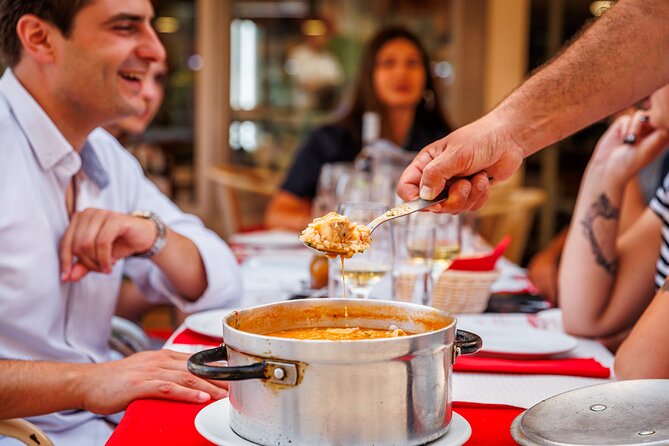
Come hungry, leave happily full. This three-hour walk through central Lisbon pairs familiar Portuguese favorites with local stories, six tasting stops, and more than 15 food and drink samples. I especially like the small groups of up to 14 and the way the route uses ordinary neighborhood eateries rather than polished tourist restaurants. I also like that the guide explains how dishes fit into Portuguese life, not just what sits on your plate.
The main drawback is dietary flexibility. Vegetarian and gluten-free alternatives may be available, but they are not guaranteed at every stop. This tour is not suitable for vegans, people with celiac disease, or anyone requiring Kosher or Halal food. You should also expect a generous amount of alcohol, including wine, beer, port, and ginjinha.
Key things to know before booking
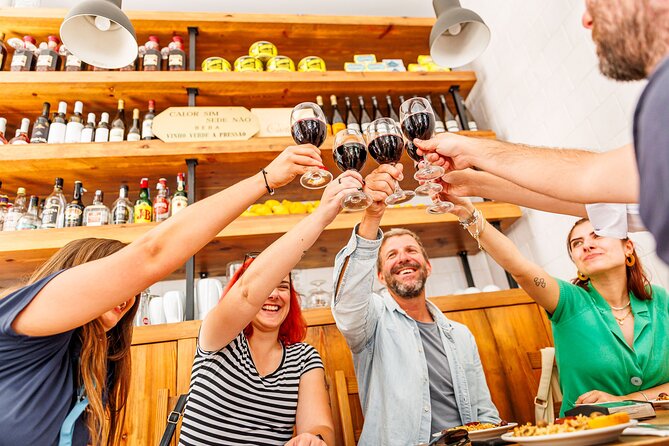
- Six stops and more than 15 tastings: Expect enough food for what feels like a full meal, not a few token bites.
- A very central route: The tour begins at Rossio Square and stays around Baixa, Rua da Madalena, and Largo de São Domingos.
- Portuguese classics: Cod cake, Vinho Verde, bifana, chouriço, cheese, port, rice, and ginjinha all appear along the way.
- Small-group atmosphere: The maximum group size is 14, though some departures have been much smaller.
- Good first-day activity: Guides often add restaurant suggestions and practical food advice for the rest of your stay.
- Bring an appetite: Several tastings include alcohol, and the portions can add up quickly.
Starting with cod cake at Rossio Square
The meeting point is Praça Dom Pedro IV, usually called Rossio Square. This is a practical place to begin because it sits in the middle of Lisbon’s historic center and is close to public transportation. It is also a lively introduction to the city, with pedestrians crossing the square in every direction and the older streets opening out around it.
Your first taste is a Portuguese codfish cake, fried when you arrive and served with Vinho Verde. Cod is central to Portuguese cooking, and beginning with this snack gives your guide an easy way to explain the country’s long affection for salted cod.
Vinho Verde is a light, refreshing Portuguese wine. It makes a sensible match for a hot, crisp cod cake, especially early in the tour. This first stop takes about 30 minutes, so you have time to eat, listen, and settle into the group rather than simply grab a bite and move on.
Rossio is also a good place to get your bearings. The tour is not just a sequence of restaurants. It uses the streets and squares as part of the lesson, connecting food with Lisbon’s daily life and past.
More Wine Tours in Lisbon
- Winner 2025 Undiscovered Lisbon Food & Wine Tour by Eating Europe
★ 5.0 · 6,390 reviews - Lisbon: Food and Wine Small Group Walking Tour
★ 4.9 · 4,082 reviews - Lisbon Food Tour with 10+ Tastings of Local Delicacies & Wines
★ 5.0 · 1,339 reviews
Baixa: six food stops in Lisbon’s historic center
Most of the food stops take place in Baixa, the central district rebuilt after the earthquake of 1755. The area brings together shops, restaurants, broad streets, old squares, and reminders of the city’s ability to recover from disaster.
The main Baixa section lasts about 90 minutes. It includes six tasting stops, although the exact locations can change. That flexibility is useful because food businesses have their own schedules, and the tour can adjust its route when needed.
Along the way, you may pause near the Carmo Convent ruins, an elegant Gothic structure left open to the sky after the earthquake. You also pass near the Rua Augusta Arch, which marks the entrance to the grand pedestrian street leading toward the river. These sights give the food stops a sense of place, and your guide may add stories about the district’s rebuilding and changing role.
The route also touches Rua Augusta and Rua da Madalena. Rua Augusta is the main pedestrian artery of the old center, while Rua da Madalena has a more local food feel away from the busiest stretch. You are not spending three hours inside one restaurant. Instead, you move between traditional venues, eating a little at each one and seeing how the center fits together.
Port, cheese, chouriço, and Portuguese small plates
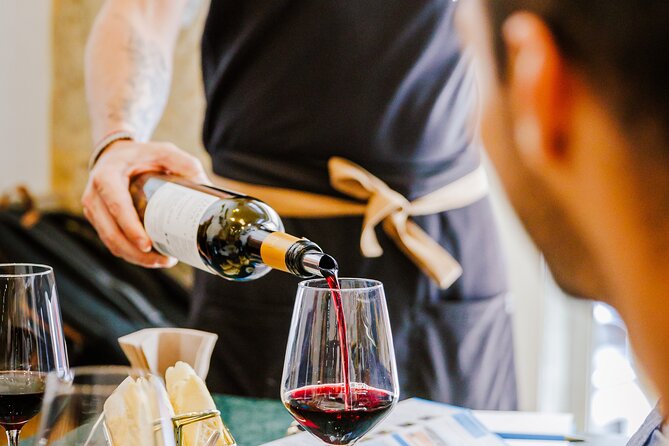
One tasting combines Portuguese cheese with port wine. Port is one of the country’s best-known protected wines, and pairing it with cheese shows why it is often treated as part of a meal rather than only as a sweet drink after dinner.
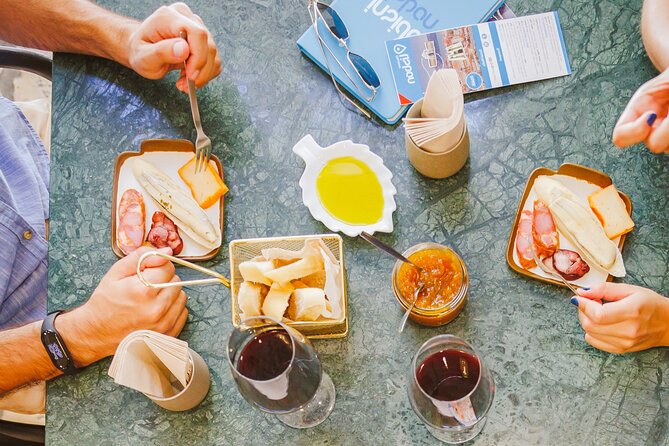
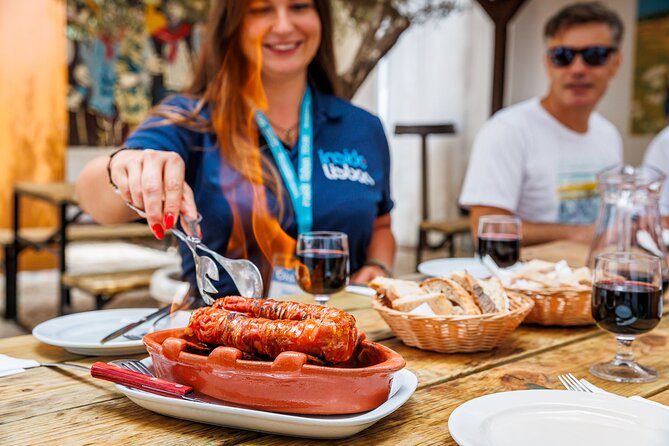
You may also taste chouriço with bread, red wine, and other petiscos. Petiscos are Portugal’s small savory dishes, similar in spirit to tapas but rooted in Portuguese ingredients and habits. They are made for sharing, chatting, and ordering another plate when the table still has room.
This part of the tour is especially useful if you want to know what to order later on your own. A guide can explain which foods are everyday fare and which drinks belong with them. It also gives you a better sense of how Portuguese eating works: bread, cheese, cured meat, wine, and small cooked dishes can form a relaxed meal without a formal starter-main-dessert structure.
Food portions are not necessarily tiny. Several people find that the tastings add up to a full meal by the end, so you should not eat a large lunch immediately beforehand. At the same time, the tour is spread over three hours, which makes the amount of food easier to manage than a single heavy meal.
Rua da Madalena and the bifana
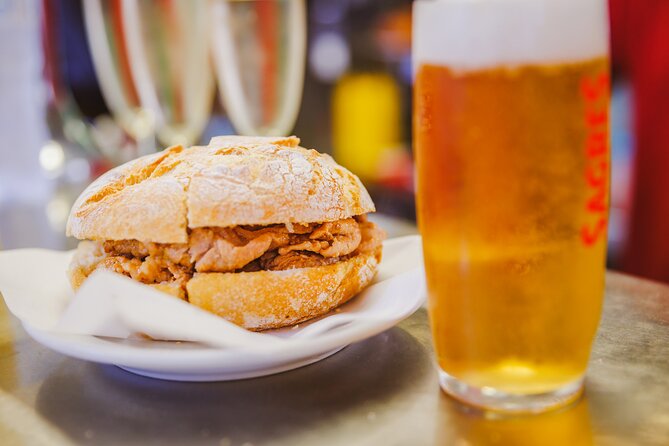
The bifana is Lisbon’s classic pork sandwich. It is simple, inexpensive, and deeply tied to everyday Portuguese eating. On this tour, you stop at a family-run tasca on Rua da Madalena for a bifana with Portuguese draft beer.
This is one of the most useful stops for understanding local food culture. The sandwich is not presented as fancy cuisine, and that is exactly the point. It is the kind of food you might order at a casual counter or neighborhood bar, especially when you want something quick and filling.
The draft beer pairing adds another practical lesson. Your guide may explain how to order beer in Lisbon, which can be handy when you later visit a tasca on your own. The stop lasts about 20 minutes, enough time to eat without turning the tour into a long restaurant sitting.
The bifana can be substantial. If you are already full from the earlier tastings, this is the point where you may wish you had followed the advice to arrive hungry. The positive side is clear value: this is not a tour where you pay for a few crumbs and still need to find lunch afterward.
More Wine Tours in Portugal
- Award-Winning Original Lisbon Food Wine Tour: 19 Curated Tastings
★ 5.0 · 1,288 reviews - Private Lisbon Arrabida Wine Tour: Food & Wines, Mountain and Sea
★ 5.0 · 907 reviews - Lisbon Private Food Tour – Taste 10+ Local Dishes & Wines
★ 5.0 · 896 reviews - Eat & Walk Through Lisbon: A Local Food & Wine Experience
★ 4.9 · 458 reviews
Largo de São Domingos and the story of ginjinha
At Largo de São Domingos, the tour turns to ginjinha, Lisbon’s sour cherry liqueur. The drink is linked to this square, where it first became popular about two centuries ago. You taste it at the original spot dating to 1840 and learn about the famous choice of having it with or without, meaning with or without a cherry in the glass.
Ginjinha is sweet, strong, and served in a small portion. It is a short tasting, but it carries plenty of local character. The square itself adds to the experience, with Portuguese pavement, old buildings, street activity, and vendors close by.
This is also one of the tour’s best examples of why a food walk can be more useful than a restaurant list. You are learning the story behind a drink, where it belongs in the city, and how locals order it. Later, if you pass a ginjinha bar, you will know what the drink is and what the small phrase with or without means.
Look uphill from here and you may catch sight of São Jorge Castle in the Lisbon light. The route does not focus on the castle, but these views help connect the food walk to the wider city.
The final rice dish and wine pairing
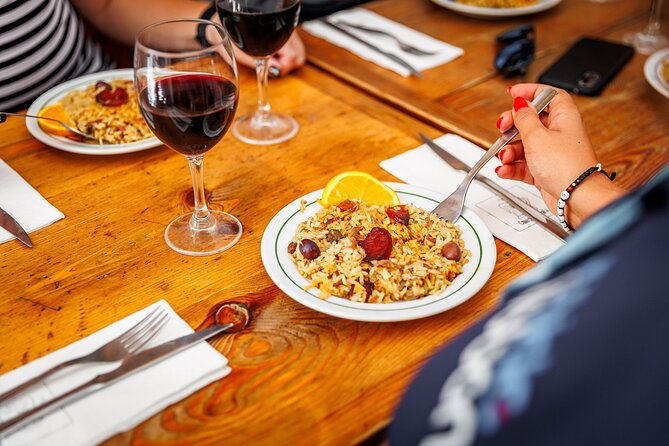
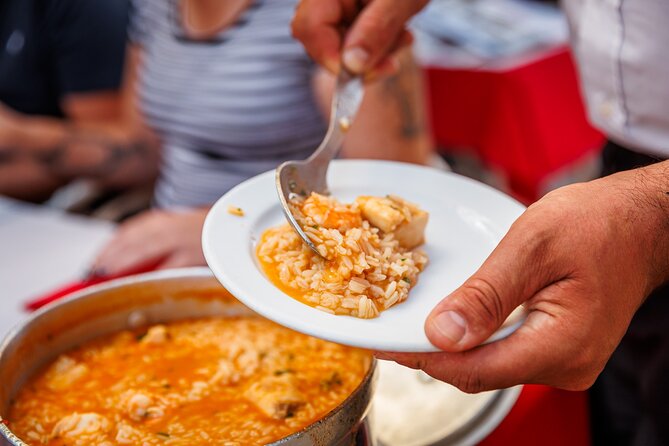
The sample menu includes a traditional Portuguese rice dish served with wine. The exact dish depends on the fresh ingredients available that day, so this is not a fixed restaurant menu. That daily variation is part of the point: Portuguese cooking often follows what the kitchen has on hand.
The guide or restaurant chooses a wine to match the dish. This gives you another example of pairing beyond the obvious cod and white wine combination. It also rounds out the tastings with something warm and substantial after the sandwiches, cheese, and small plates.
A sample menu also includes port, more cheese, bread, chouriço, and additional tapas. In total, the food can feel like a grazing meal across the center of Lisbon. One group described finishing with seafood rice, port, bifana, cod cake, ginjinha, wine, cheese, and sardines. Your exact selection may differ because the food locations and available dishes can change.
What the guides add to the experience
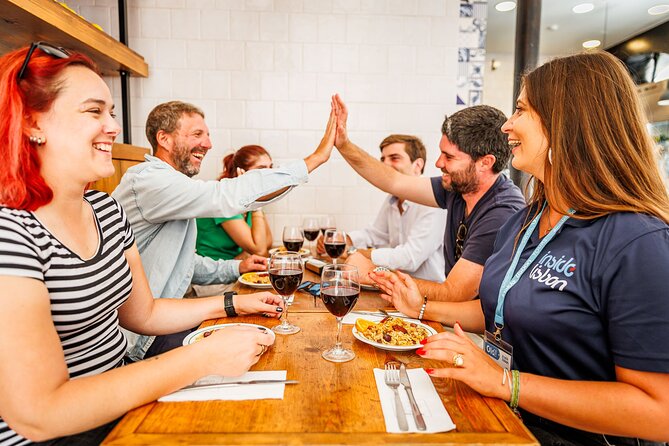
The guide matters a great deal here. The strongest departures have been led by people such as José, Alex, Filipe, Filipa, Martin, Pedro, Carlos, Guilherme, Katerina, Daniel, and Franco. The best guides do more than lead you from door to door. They explain Portuguese food, share city history, answer questions, and suggest places to eat after the tour.
Several guides are praised for making everyone feel included. That matters in a food tour because the group eats together repeatedly, and a quiet or disorganized guide can make the experience awkward. A good guide keeps the pace moving while giving you enough time to eat and talk.
The group size is capped at 14, but some departures are much smaller. One group had only three participants plus the guide, while another had four guests and two guides. Smaller groups allow more conversation and make it easier to ask about restaurants, wine, or food customs.
The social side is part of the appeal. You may share tables or tasting counters with people from different countries, and the repeated stops naturally give everyone a chance to talk. If you prefer to eat privately or move at your own pace, a self-guided food crawl may suit you better.
Is $76.19 a fair price?
At $76.19 per person, the tour is not the cheapest way to eat in Lisbon. But the price includes six stops, more than 15 tastings, several alcoholic drinks, a local guide, and a three-hour walking route. If you tried to recreate the same range of dishes and drinks on your own, you would also spend time choosing places and navigating between them.
The value is strongest for a first visit. You get an introduction to foods you might otherwise overlook, plus ideas for restaurants and bars to try later. The tour can also replace one substantial meal, which makes the cost easier to justify.
The value is weaker if you already know Lisbon’s food scene or do not drink alcohol. A large share of the experience involves wine, beer, port, and ginjinha. You can still learn from the food and city stories, but the price makes less sense if you plan to skip most of the drinks.
Timing, walking, and practical details
The experience lasts about three hours. It starts at Rossio Square and ends in Baixa de Lisboa, although the final point can vary with the route. Hotel pickup and drop-off are not included, so you need to reach the starting square yourself.
The route stays in the central Lisbon area and includes regular walking between stops. One particularly useful point is that the route avoids the city’s famously steepest hills, and it has been described as manageable for people who want to walk without tackling a physically demanding route. Still, you should expect time on your feet and Portuguese pavement, which can be uneven.
Wear comfortable shoes and avoid arriving after a heavy meal. The tour is offered in English and uses a mobile ticket. Food and drink locations may change, so the precise order and menu are not guaranteed.
Dietary restrictions deserve careful attention. Vegetarian and gluten-free choices may be possible at some stops, but alternatives cannot be promised. The experience is not suitable for celiacs, vegans, or people requiring Kosher or Halal food. Pregnant people and anyone with a serious food allergy should contact the provider before booking, since traditional venues may not be able to adapt dishes safely.
Free cancellation is available up to 24 hours before the start time. A cancellation inside that window is not refundable, and the tour requires a minimum number of participants to operate.
Who should book this Lisbon food tour?
I would choose this tour for a first or second day in Lisbon. It helps you get oriented, introduces dishes you can seek out later, and gives you restaurant tips while the rest of your trip is still ahead.
It is also a good fit if you like a full schedule of small tastings rather than one long meal. The guides bring energy and humor, and the compact group makes it easy to ask questions.
I would skip it if you need strict dietary control, dislike alcohol, or want an in-depth culinary class. This is a guided eating walk through the city, not a cooking lesson or a private restaurant experience.
Should you book the Lisbon food and wine tour?
Yes, if you eat meat and seafood, enjoy wine and local liqueurs, and want an easy introduction to Lisbon’s everyday food. The cod cake with Vinho Verde, bifana with beer, port and cheese, and ginjinha at its historic source give you a broad taste of the city in a short time.
Book it early if your dates are fixed, since it is often reserved more than a month ahead. For the best experience, choose a departure near the start of your stay, arrive hungry, wear good shoes, and treat the guide’s recommendations as part of what you are buying.
FAQ
How long does the Lisbon food and wine tour last?
The tour lasts approximately three hours.
Where does the tour begin?
It begins at Praça do Rossio, also called Rossio Square, in central Lisbon.
Where does the tour end?
It ends in Baixa de Lisboa, though the exact end point can vary depending on the route.
How many food and drink tastings are included?
The experience includes six tasting stops with more than 15 food and drink tastings.
What foods and drinks might I try?
Possible tastings include codfish cake with Vinho Verde, port with Portuguese cheese, a bifana with draft beer, chouriço and bread with red wine, a traditional Portuguese rice dish with wine, and ginjinha.
Is the tour suitable for vegetarians or people avoiding gluten?
Vegetarian and gluten-free alternatives may be available, but they are not guaranteed at every stop. The tour is not suitable for vegans, people with celiac disease, or those requiring Kosher or Halal food.
What is the cancellation policy?
You can cancel for a full refund up to 24 hours before the experience begins. Cancellations made less than 24 hours before the start time are not refunded.
Just added in Lisbon
- No Diet Club – Unique food tour in Lisbon with many Tastings★ 4.9 · 50 reviews
- Lisbon Small-Group Food & Wine Tour Eat & Drink like a Local★ 4.9 · 77 reviews
- Lisbon: Private Food Tour – 10 Tastings with Locals★ 4.8 · 73 reviews
- Lisbon: Portuguese street food cooking class with Drinks★ 4.9 · 37 reviews
- Lisbon: Private Food & Wine City Tour by Eco Tuk Tuk★ 4.8 · 21 reviews
- Lisbon: Food and Culture 3-Hour Walking Tour★ 4.7 · 95 reviews
- Lisbon Private Setúbal Region Wine Tasting Tour★ 4.9 · 149 reviews
- Food Tour: Portuguese wine & Tapas with Ginjinha Tasting★ 3.8 · 67 reviews
Wine Tours, compared.
Winner 2025 Undiscovered Lisbon Food & Wine Tour by Eating Europe
Read our review →
Winner 2025 Florence Sunset Food & Wine Tour by Eating Europe
Read our review →
Authentic Parisian Gourmet Food Tour with 10 Local Dishes & Wines
Read our review →
Tapas Walking Tour with Food, Wine, and History
Read our review →
Madrid Tapas & Wine Tasting Walking Tour – Small Group Local Bars
Read our review →Browse the lists this tour appears in