
REVIEW · OSAKA FOOD TOURS
Osaka: Cooking Class Ramen & Gyoza Course in Nanba
Fresh noodles, folded dumplings, and a cold drink.
This hands-on Osaka class gives you more than a meal. You make ramen noodles from scratch, prepare gyoza with pork and vegetables, and sit down to eat what you cooked. I especially like the small-group format, limited to eight people, and the friendly English-speaking instruction. The recipe cards are another real plus, since you can try the dishes again at home.
The main point to check is the timing. The activity is advertised as two hours, but the detailed schedule describes 30 minutes of orientation, 1.5 hours of cooking, and a one-hour tasting session, which adds up to three hours. Confirm the start and finish time before booking, especially if you have dinner plans afterward.
Key details before you book
- You make ramen noodles from scratch: This is not just a demonstration. You work with the flour and take part in the noodle-making process.
- Gyoza folding is a main event: The instructors show you how to shape the dumplings, then give you time to practice.
- The group is capped at eight: That leaves room for questions and individual help without turning the class into a private lesson.
- Your meal comes with drinks: Sake, beer, and soft drinks are included during the tasting session.
- Recipes go home with you: The instructions are designed to help you repeat the dishes after your trip.
- The class is held at Dear Court Semba 303: You enter through a doorbell panel and go to Room 303 on the third floor.
What you actually cook in Osaka
The appeal here is simple: you do not just watch someone prepare Japanese food. You handle the ingredients, follow the steps, and eat the finished meal while the process is still fresh in your mind.
The two dishes make a good pair. Ramen gives you the satisfaction of working with noodles and broth, while gyoza provides a more tactile task. Folding dumplings looks easy when an experienced cook does it. Your first few may come out a little lopsided, which is part of the fun.
The class focuses on traditional Japanese-style cooking, with professional Washoku instructors guiding the group. The ingredients and tools are provided, so you can arrive with nothing more than yourself and an appetite.
That makes this a useful choice if you are staying in Osaka without access to a kitchen. You still get the pleasure of cooking, but you do not need to buy unfamiliar ingredients, locate equipment, or worry about cleaning up afterward.
More Cooking Classes in Japan
- Osaka: Ramen and Gyoza Cooking Class in Dotonbori
★ 5.0 · 378 reviews - Osaka: Roll and Authentic Sushi Making Class in Dotonbori
★ 4.9 · 239 reviews - Osaka: Gluten-Free Ramen and Gyoza Cooking Class
★ 5.0 · 42 reviews
Starting with orientation and preparation
The session begins with a 30-minute orientation and preparation period. This is where you get familiar with the kitchen, ingredients, tools, and the basic sequence of the meal.
That opening matters for beginners. Ramen and gyoza both have several small steps, and a clear introduction keeps the class from feeling rushed. You can also use this time to get comfortable asking questions in English or Japanese.
The instructors are fluent in both languages. Several instructors have been praised for patient, easy-to-follow explanations, including Nana, Yuriko, Kyota, Keiichi, Mimi, Yuma, Ryota, Saya, and Kiho. The teaching team may vary, but the pattern is consistent: practical guidance, friendly conversation, and plenty of help at the work surface.
The class takes place in a group setting. That means you will cook alongside other people rather than receive a private chef lesson. For many people, this adds to the evening, since the meal becomes a shared activity with people from different countries. If you prefer quiet, individual instruction, the group format may feel less personal.
Making ramen noodles by hand
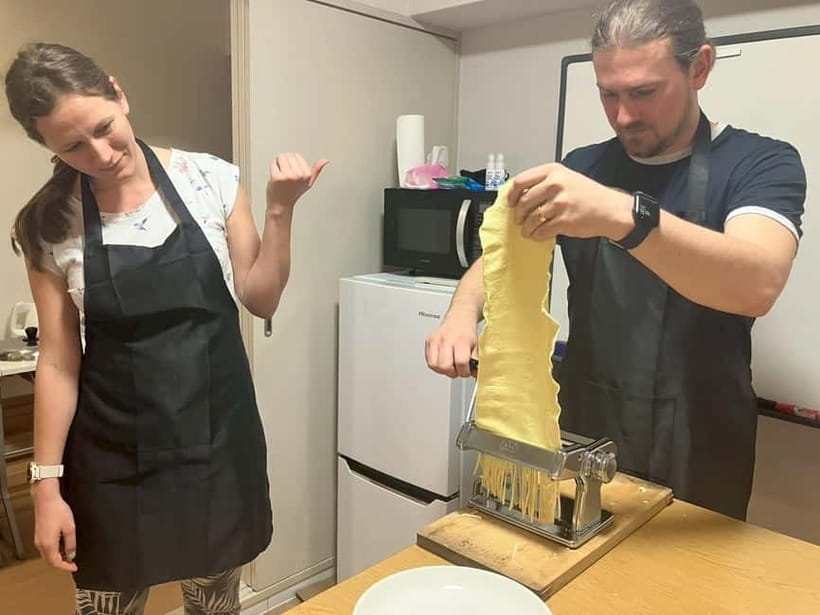
The most unusual part of the class is making the ramen noodles yourself. You work with the flour and learn how the dough becomes the noodles used in the finished bowl.
Making noodles from scratch gives the meal more meaning than simply adding toppings to a prepared soup. You see the work involved in a food that is often served quickly and casually in Japan. The process also gives you a skill you can attempt again at home, provided you can find the needed ingredients.
The class is suitable for beginners, and you do not need previous cooking experience. One participant described arriving with little confidence and leaving surprised by how well the food turned out. That is a good indication of the class style: structured enough to keep you on track, but relaxed enough to let you enjoy the work.
Expect to take part rather than stand back. You may chop vegetables, prepare ingredients, work with the noodle dough, and help bring the dish together. The exact order can depend on the group and the instructors, so the important point is that this is active cooking from start to finish.
Learning to fold gyoza properly
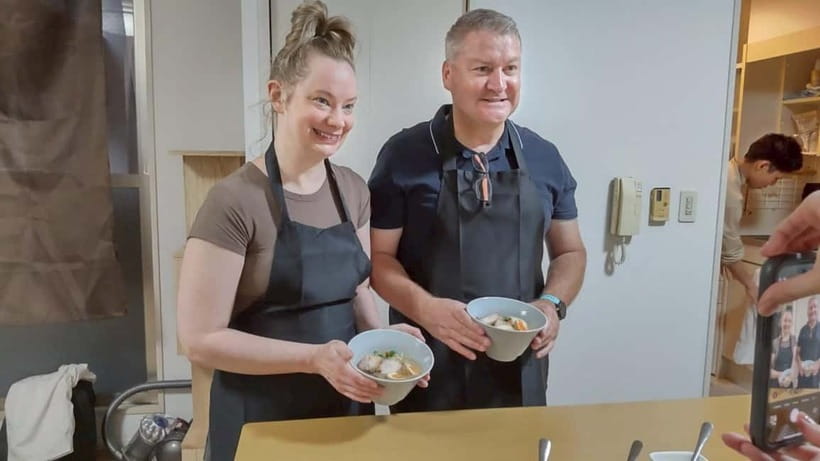
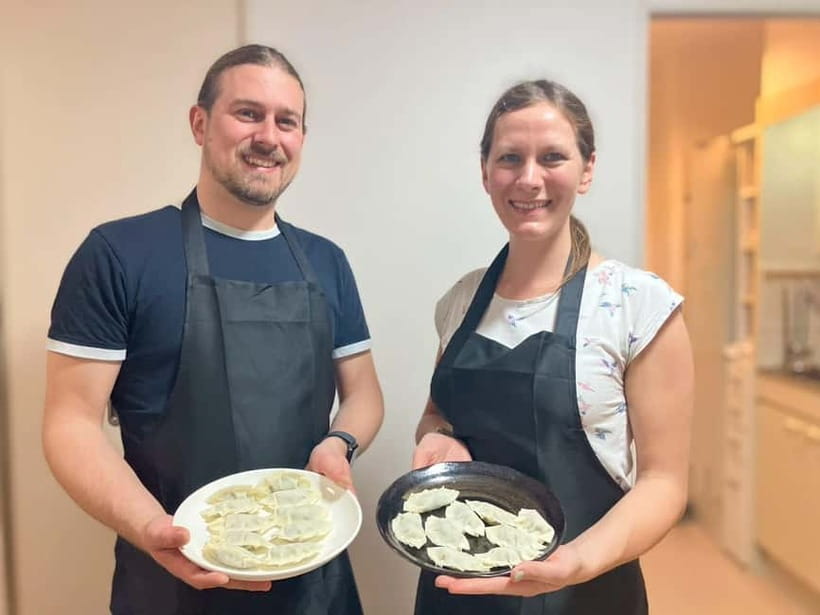
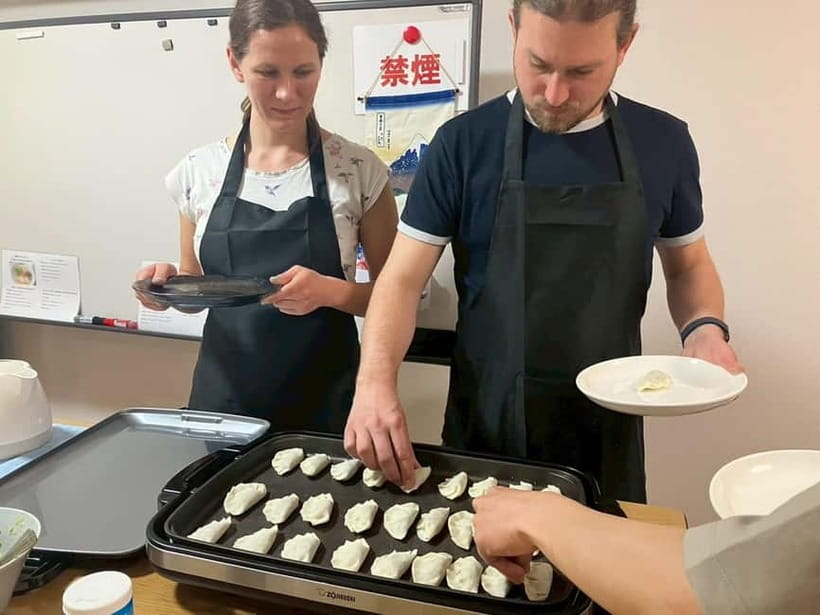
Gyoza folding is where the class becomes part cooking lesson and part hand-skill challenge. You prepare the filling, place it in the wrappers, and learn the folds that give the dumplings their familiar shape.
The instructors demonstrate the technique carefully. Then you repeat it until the motion begins to make sense. Do not worry if your first dumplings resemble small parcels rather than neat restaurant gyoza. The point is to learn the method and enjoy the practice.
Several participants singled out the folding lesson as especially memorable. The instructors were praised for being patient and for making sure everyone could take part. That is important in a small group, since cooking classes can otherwise move at the speed of the fastest person at the table.
The filling includes vegetables and pork in the standard version. Vegetarian and vegan adaptations have been provided in past classes, and one participant with vegan requirements was accommodated successfully. If you need a special version, confirm it when booking rather than waiting until the class begins.
More Sushi and Ramen Tours in Osaka
- Sushi Making Osaka Roll and Authentic Japanese Sushi Class
★ 5.0 · 1,220 reviews - Osaka: Five Must-See Highlights Walking Tour & Ramen Lunch
★ 4.7 · 411 reviews - Osaka Sushi Making Experience
★ 5.0 · 400 reviews - Osaka: Sushi Class in Dotonbori
★ 4.9 · 160 reviews
The tasting session: eat what you made
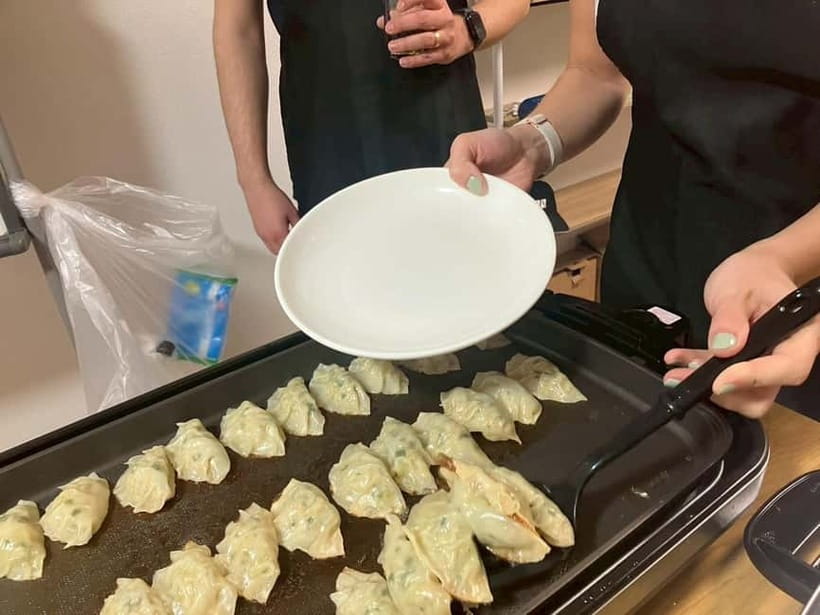
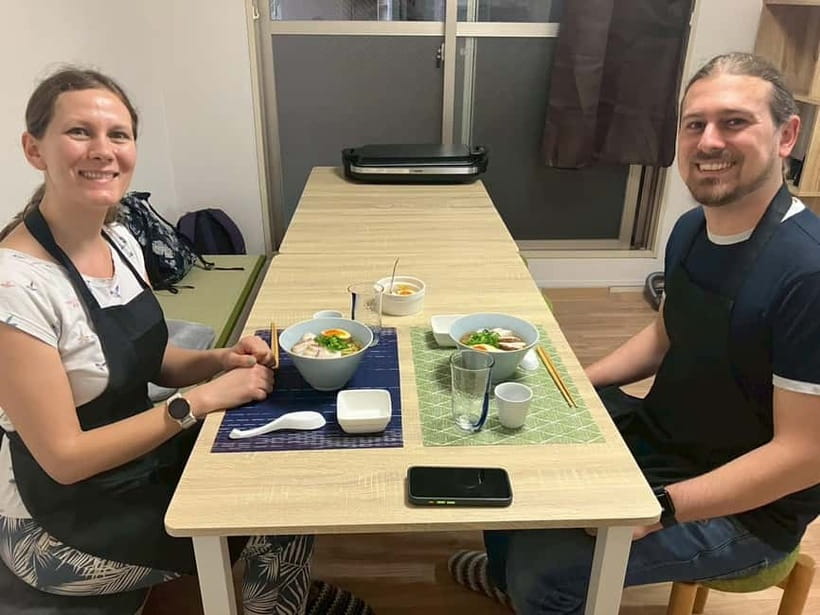
After the cooking, you sit down to enjoy your ramen and gyoza. The tasting portion includes sake, beer, and soft drinks, giving you a relaxed way to finish the class.
I like this structure because the reward comes directly from your work. You can compare the finished food with the technique you just learned, and you are likely to notice details you would miss if the meal had simply been placed in front of you.
The food has received especially strong praise. People repeatedly described the ramen and gyoza as delicious, with several highlighting the flavor achieved during the class. One participant called it the best ramen they had eaten, while another was particularly impressed by the gyoza.
Drinks are included only within the provided tasting session. Additional food and drinks cost extra, and hotel pickup or drop-off is not included. The class itself is the attraction, not a full evening meal with a long menu, so keep your expectations focused.
One small point may matter to you: the meal is generally enjoyed among the participants, rather than as a sit-down dinner with the instructors. Some people would prefer to eat together with the cooking team. Others will appreciate having time to chat with the group and enjoy the food at their own pace.
A small group with a social feel
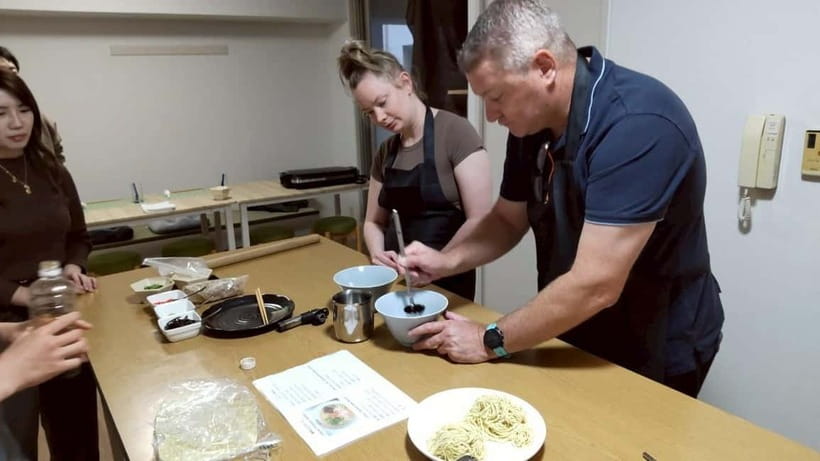
With a maximum of eight participants, the class has a useful middle ground. You get the social energy of a group activity, but the number is small enough for the instructors to watch your technique and answer questions.
That format works well for families, friends, couples, and solo visitors. A family of five found the class suitable for both teenagers and adults. Solo participants can also join without feeling stranded, since the cooking naturally creates conversation.
The instructors are not just there to read instructions. They demonstrate, correct small mistakes, and keep the mood light. The class has been described as feeling more like cooking with friends than attending a formal lesson. That relaxed tone is valuable in Osaka, where an evening activity can be as much about meeting people as learning a recipe.
The tradeoff is that the pace may not be entirely your own. You will be cooking as part of a group, so you may need to wait briefly for a shared step or keep up with the instructor. This is normal for a small cooking class, but it is worth knowing if you want a slow, highly customized lesson.
Finding Dear Court Semba 303
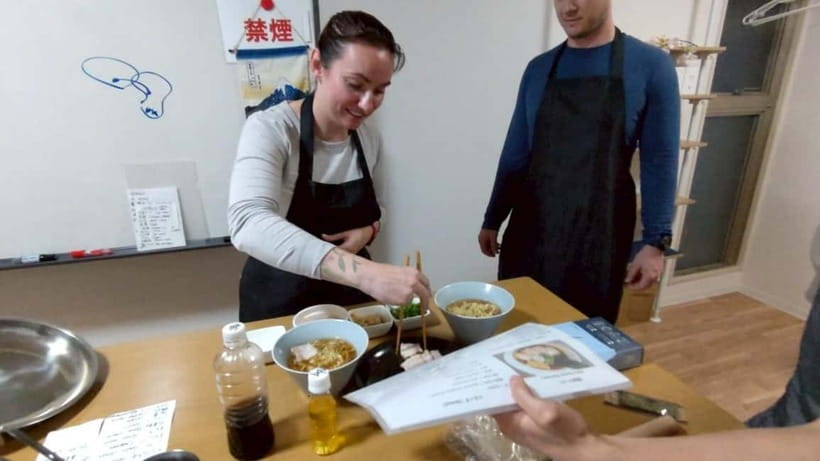
The meeting point is:
Dear Court Semba 303
4-chōme-3-1 Bakurōmachi
Chuo Ward, Osaka 541-0059, Japan
The class is held in Room 303 on the third floor of the building. At the entrance, look for the doorbell panel and press 303, followed by the button marked Call 呼. Once the door opens, use the stairs or elevator to reach the room.
The building can be easy to miss because the cooking space is inside an apartment-style property rather than a prominent restaurant. One family had trouble finding it and described it as tucked a block behind the Ferrari dealership, near a large stairway leading to a gym and an outdoor lounge area with couches.
Give yourself extra time to locate the entrance. If you have trouble, the provider says you can call or send a message. This is one of those moments when a screenshot of the address and entry instructions is worth keeping on your phone.
The activity is listed under Osaka and Nanba, but the stated meeting point is in Chuo Ward at Bakurōmachi. Use the exact address provided for navigation rather than relying only on the activity title.
Price, timing, and what the $70 covers
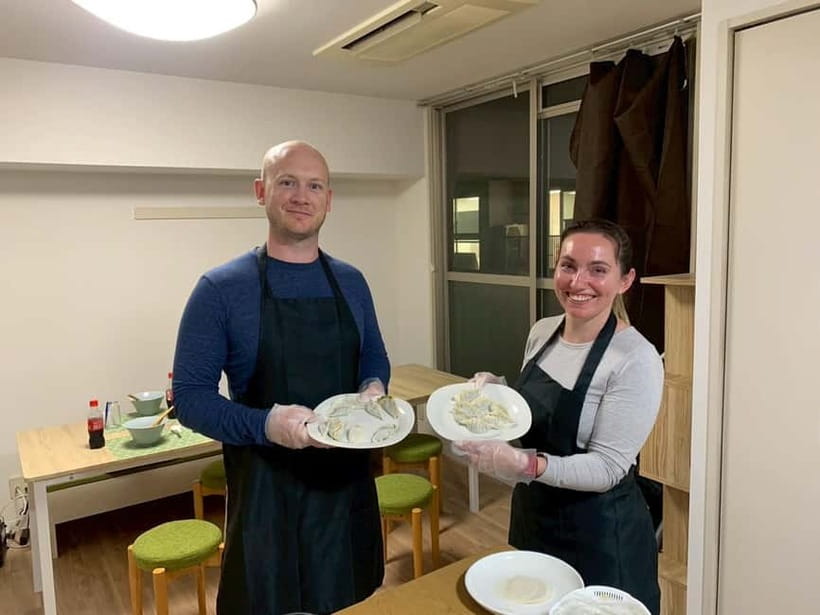
At $70 per person, this is not the cheapest meal in Osaka. It is a fair price if you want instruction, ingredients, kitchen equipment, drinks, and a hands-on cultural activity in one package.
You are paying for more than the food. The value comes from the professional guidance, the noodle-making process, the gyoza practice, the small group, and the recipes you take home. If you only want to eat ramen, a restaurant will cost less and require far less time. If you want to understand how the meal comes together, the class earns its price more easily.
The stated duration is two hours, but the supplied schedule lists:
- 30 minutes for orientation and preparation
- 1.5 hours of hands-on cooking
- 1 hour for tasting
That is three hours in total. Since the information does not fully match, check the available start times and expected end time before you commit. This matters if you have theater tickets, a train, or a dinner reservation.
Booking is required at least one day ahead. You can cancel up to 24 hours before the activity for a full refund, and the reserve-now-pay-later option lets you hold a place without paying immediately. The class is wheelchair accessible, though you may still want to confirm the building access details directly if you have specific mobility needs.
Who will enjoy this class most
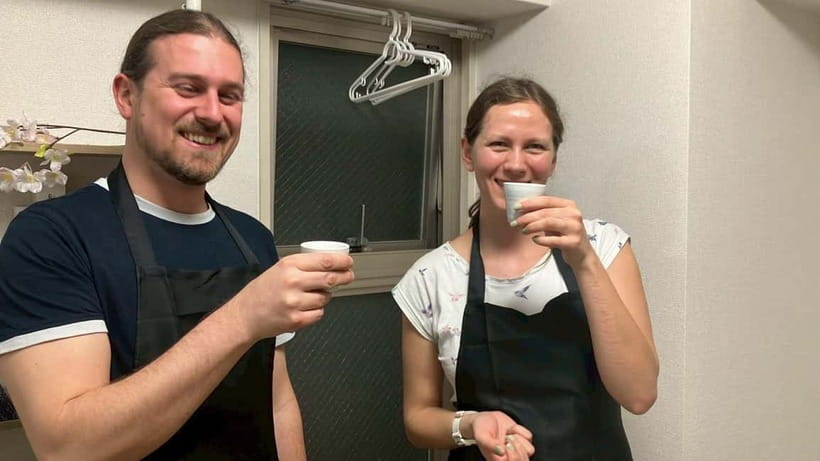
I would recommend this experience to you if you like food enough to want to understand how it is made. It is particularly well suited to:
- First-time visitors looking for a practical Japanese food experience
- Families with older children and teenagers
- Solo visitors who enjoy meeting people while doing an activity
- Couples and friends who want a shared evening
- Beginners who like clear instruction rather than a demanding culinary course
- Vegetarian or vegan participants who can arrange an appropriate version in advance
You may want to skip it if you are short on time, dislike group activities, or only want a quick bowl of ramen. The possible three-hour schedule also makes it less suitable for a tightly packed evening.
The recipes add lasting value. You may not find every ingredient easily at home, and some Japanese items can be difficult to source outside Japan. Still, the recipe cards give you a clear starting point, and the techniques for folding gyoza and making noodles are useful even if you need to adapt the ingredients.
My booking verdict
I would book this class if I had a free evening in Osaka and wanted to do more than visit restaurants. The strongest reasons are the handmade ramen noodles, the patient gyoza instruction, the eight-person limit, and the chance to eat a meal you prepared yourself.
The class has earned a 4.9 rating from 86 reviews, with repeated praise for the hosts, food, English instruction, and welcoming atmosphere. That praise is supported by specific details: instructors help with difficult folds, include the whole group, explain the recipes clearly, and have accommodated vegetarian and vegan meals.
Before booking, confirm the actual duration and tell the provider about dietary needs. If those details work for your schedule, this is a worthwhile Osaka activity with a useful souvenir: the confidence to make ramen and gyoza again at home.
FAQ
How long does the ramen and gyoza class last?
The activity is advertised as two hours, but the detailed schedule lists 30 minutes of orientation, 1.5 hours of cooking, and one hour of tasting. Confirm the exact timing before booking because those parts add up to three hours.
How much does the cooking class cost?
The listed price is $70 per person.
Where does the class meet?
It meets at Dear Court Semba 303, 4-chōme-3-1 Bakurōmachi, Chuo Ward, Osaka 541-0059, Japan.
How do I enter the building?
Press 303 on the entrance doorbell panel, then press the Call 呼 button. After the door opens, take the stairs or elevator to Room 303 on the third floor.
What languages are spoken during the class?
Instruction is available in English and Japanese.
Are drinks included?
Sake, beer, and soft drinks are included during the tasting session. Additional food and drinks are not included.
Is the class suitable for beginners and wheelchair users?
Yes. The class is designed for beginners and is listed as wheelchair accessible. It is held in a group of no more than eight participants.
More Workshops in Osaka
- Sushi Making Tokyo Roll and Authentic Japanese Sushi Class
★ 5.0 · 3,971 reviews - Tokyo: Sushi Making Class in a Happi Coat near a Famous Spot
★ 4.9 · 1,377 reviews - Tokyo Sushi Making Class in Tsukiji with Professional Chef
★ 5.0 · 1,177 reviews - Athens: Food Market Visit and Cooking Class with Wine
★ 4.9 · 1,087 reviews
More cooking classes in Osaka
- Authentic Pizza Making Class in Naples with Appetizers and Drink
★ 5.0 · 3,178 reviews - Tokyo: Roll and Authentic Sushi Making Class in Asakusa
★ 4.9 · 1,957 reviews - Ramen Cooking Class at Ramen Factory in Kyoto
★ 5.0 · 1,937 reviews - Small Group Cooking Class & Market Food Tour in Florence
★ 5.0 · 1,574 reviews
Just added in Osaka
- Hidden Osaka – Yukaku Red Light Tour & Culinary Adventure★ 4.8 · 96 reviews
- Eat Like a Local in Osaka – Private Custom Street Food Tour★ 4.3 · 33 reviews
- Osaka: Sushi Class in Dotonbori★ 4.9 · 160 reviews
- Osaka: Sushi Making in Spacious Studio (SAME-DAY OK!)★ 5.0 · 75 reviews
- Osaka: Gluten-Free Ramen and Gyoza Cooking Class★ 5.0 · 42 reviews
- Osaka: Kuromon Market Food Walking Tour (6 stops, 6 tastes)★ 4.6 · 272 reviews
- Osaka: Roll and Authentic Sushi Making Class in Dotonbori★ 4.9 · 239 reviews
- Osaka: Guided Food Tour with 12 Dishes at 4 Local Eateries★ 4.9 · 90 reviews
Cooking Classes, compared.
Authentic Pizza Making Class in Naples with Appetizers and Drink
Read our review →
Roll and Authentic Sushi Making Class in Asakusa
Read our review →
Ramen Cooking Class at Ramen Factory in Kyoto
Read our review →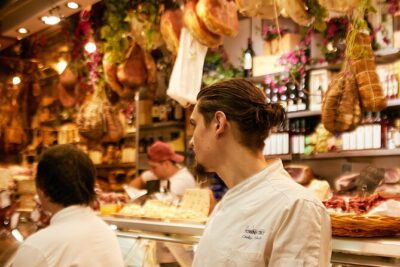
Small Group Cooking Class & Market Food Tour in Florence
Read our review →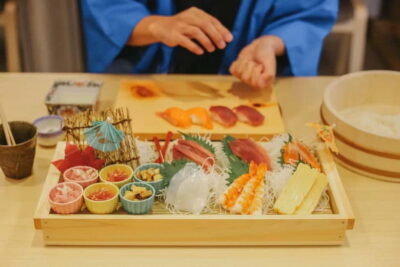
Sushi Making Class in a Happi Coat near a Famous Spot
Read our review →
Tokyo Sushi Making Class in Tsukiji with Professional Chef
Read our review →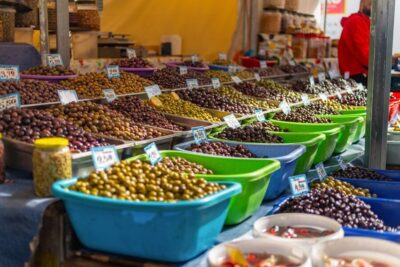
Food Market Visit and Cooking Class with Wine
Read our review →
Browse the lists this tour appears in